
Pokémon: Let’s Go, Pikachu! and Let’s Go, Eevee! are the first two Pokémon games that will release on Nintendo Switch later this year. They are not the big main RPG games but take a different approach. By combining the iconic world of Pokémon Yellow with mechanics found in Pokémon Go, the developers created a new type of Pokémon game. The Let’s Go games are clearly aimed at a younger audience but after spending some time with it, I’m sure a lot of Pokémon fans will absolutely adore this new approach too.
Welcome back to Kanto
Before I could go hands-on with the game, a Nintendo staff member showcased some of the things you need to know. The hands-on demo is set in Viridian Forest but the demo of the presentation went a little further. In Pokémon: Let’s Go, Pikachu! you’ll control a female or male Pokémon trainer who’s on a quest to become the very best. The entire game is set in the Kanto region since it’s basically a remake of the classic Pokémon Yellow, this also means you’ll recognize a lot if you played that game before. The first thing I noticed during this presentation (and later the actual hands-on), was the new visual style. It looks a bit more cartoony than before due to the bigger heads but all in all, the game looked incredibly good. Since the Pokémon are no longer hidden in the grass, the world really comes to life with Pokémon running and flying around everywhere you look.
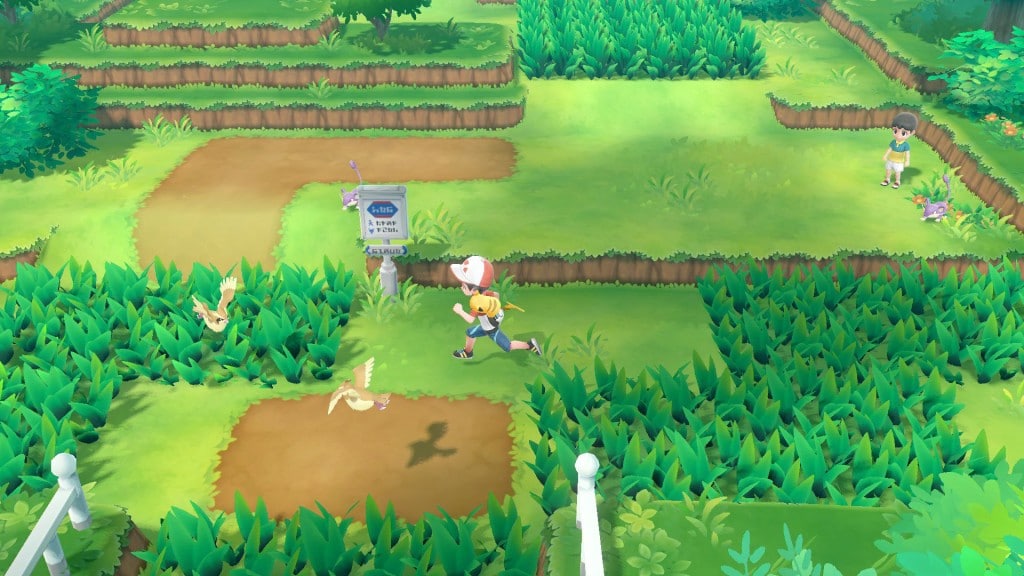
The presentation served as a great introduction to this vivid and colorful world but it also demonstrated how to catch Pokémon and how to bond with them, I’ll come back to this later on. What I would like to point out is what happened after we managed to get out of the woods. We entered the first big city and it’s here where nostalgia truly kicks in. Sister Joy is still head of the Pokémon Centre, Brock is still the first gym leader and those hilarious dialogues are all still there. Of course, there are some small additions to the old games too. For example, we could look after a Slowpoke for a while, resulting in some funny gameplay minutes.
Gotta Catch ‘Em All
As said before, the actual hands-on demo didn’t let us go to the city, instead, we were free to discover all the secrets Viridian Forest has to offer. Since this still is a Pokémon game, collecting all those Pokémon is one of the main tasks. Unlike the older games, you see the Pokémon running around in the world. Most of them like to hide in the tall grass but some go off route too, making it harder to spot your favorite Pokémon. If you see one you like, you can simply bump into it to start the catching mechanic. Unlike the main games, you won’t battle the wild Pokémon. Instead, you see a screen similar to Pokémon Go, including the circle around the Pokémon. Once you throw your Poké Ball (you can make the iconic throwing gesture to do so), you’ll have a chance of capturing the Pokémon. Of course, this is a lot easier than it ever was but it still comes with some challenges.

Rare Pokémon aren’t easy to catch since they’ll run away the moment they spot you. I was running after a Butterfree pretty long before I was able to activate the catching mechanic. Once you manage to initiate the catching screen of a rare Pokémon, you’ll notice you’ll need some better Poké Balls than the regular ones and the Pokémon isn’t exactly standing still in the center of the screen. I was pleasantly surprised with this extra challenge since it required multiple throws and Poké Balls before I caught the Pokémon. I’m sure this challenge will be even bigger for truly legendary Pokémon.
Since the amount of Pokémon running around in the world can be rather overwhelming, the team made sure to add some indicators. Some Pokémon had a blue glow over them, indicating they are rather small for their species. Others had a red glow, showing you those are huge for their species. It’s unclear why the size of the Pokémon matters but I’m sure there’s a hidden gameplay element we haven’t learned of just yet. Hunting for Shiny Pokémon? You can easily spot them in the overworld since they’ll have small stars surrounding them. You don’t need to enter the capture screen like you need to do in Pokémon Go, this time, you can just spot them in the world but they’re still extremely rare.
Battle other trainers
Capturing Pokémon formed the biggest part of the hands-on gameplay but I was able to battle against others too. Unlike the main games, you won’t battle wild Pokémon, instead, you can only battle the CPU characters waiting for you. In the Forest, I faced multiple enemies but none proved a challenge. For the sake of the demo, my Pokémon were a lot stronger than my opponents but it did demonstrate the battle mechanic. Unlike capturing, battling did remain the same as in the core games, meaning you’ll attack in turns and have to use the type of Pokémon to your advantage in order to use a super effective attack. I’m sure a lot of veteran players will be more than happy to battle in this familiar way. During battles, you’re not limited to your companion Pokémon, you can easily switch between the other Pokémon you caught too. New, however, is the fact that your entire party gains experience for a battle, probably solving the lack of wild battles.

All in all, it’s good to have the more core battles in a more mainstream orientated game. Since it’s aimed at a younger audience, the game will hold your hand during your journey a lot more than you’re used to. Before battling in a Gym for example, you’ll have to prove that you have a strong Pokémon in your party, saving you a disappointing outcome otherwise. After my hands-on, it’s clear that the game is a lot more forgiving than the original games, even your rival helps you out with items at times where you’ll need it the most. It doesn’t take away the fun but veteran players should really take this into consideration. Don’t expect a challenging Pokémon game here, this is meant as a fun introduction to the main games for the younger gamers or Pokémon Go crowd.
The Poké Ball Plus
My entire hands-on session was played using the new Poké Ball Plus. I must say, I’m surprised by the quality of the product. It feels extremely good to hold and has the exact right weight. It’s like holding a Poké Ball from the series in the palm of your hands. In the center of the Ball, you’ll find a small analog stick to walk around or select certain things in the menus. By clicking the stick, you confirm a selection. On the back of the Ball, you’ll find a B-button, to decline selections or to run away from combat. Besides controlling the game with it, you can also place a Pokémon inside the Ball that will even make its specific sound when you move the Ball around. You can also swirl the Ball gently on the palm of your hand to ‘relax’ your Pokémon, increasing the bond you’ll have with it. It’s a fun gadget to have and thanks to the motion sensors, it’s a lot of fun capturing those Pokémon while mimicking some of the best Pokémon trainers out there.

Early conclusion:
Pokémon: Let’s Go, Pikachu! offers a different approach to a formula we all learned to love. It’s a more casual Pokémon experience but that doesn’t take away that there still is some challenge to be found. The world is beautifully created and never came to life as much as it does now. I’m sure everybody will find something to love in this game and I can’t wait to see what surprises the final product will hold.
